Dynamic vs Condenser, Wired vs Wireless, Handheld vs Headset: Which Microphone Do You Need?
· 5 min read · Party Backline
The right microphone makes the difference between a speech everyone hears clearly and one lost to feedback and crackle. Picking one comes down to three choices: dynamic or condenser, wired or wireless, and handheld or headset. Here's what each means and which one suits your event.
Dynamic vs condenser microphones
This is about how the microphone turns sound into an electrical signal, and it decides how the mic behaves on a live stage.
Dynamic microphones: the live-sound workhorse
A dynamic mic uses a moving coil and magnet. It's less sensitive than a condenser, and for live events that's an advantage: it mostly picks up what's directly in front of it, rejects room noise and is much less prone to feedback through the PA. Dynamic mics are also tough, need no power and handle very loud sources.
- Best for: live vocals, speeches, MCs, karaoke, guitar amps, snare and toms.
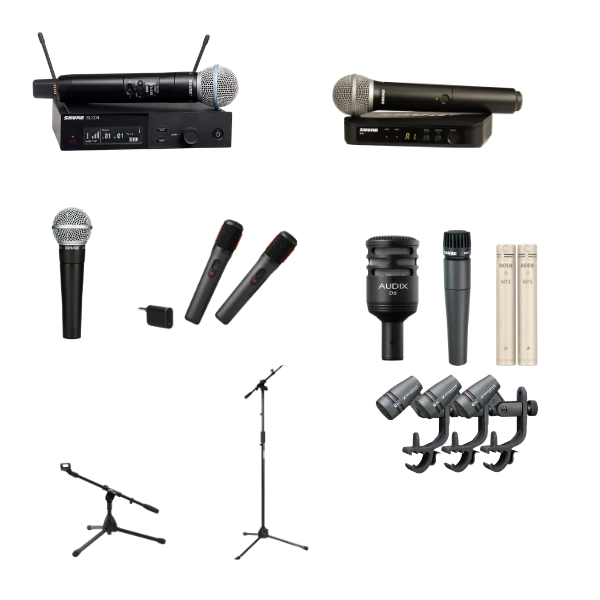
- Examples we hire: the Shure SM58 (the industry-standard vocal mic), plus the Shure SM57, Audix D6 and Sennheiser e604 in our drum microphone set. The handheld capsules on our Shure BLX (PG58) and SLXD (Beta 58) wireless systems are dynamic too.
Condenser microphones: detail and sensitivity
A condenser mic uses a very thin, lightweight diaphragm that reacts to the smallest changes in air pressure. That makes it far more detailed and sensitive, perfect for capturing the shimmer of cymbals or an acoustic guitar. The trade-off: it also picks up more of the room and is more likely to cause feedback near loud speakers. Condensers need phantom power (48V) from the mixer.
- Best for: drum overheads, acoustic instruments, choirs, ensembles and recording.
- Example we hire: the pair of Rode NT5 overhead condensers in our drum microphone set.
| Dynamic | Condenser | |
|---|---|---|
| Sensitivity | Lower, focused on the source | High, captures fine detail |
| Feedback resistance | Excellent | Lower near loud speakers |
| Power needed | None | Phantom power (48V) |
| Durability | Very rugged | More delicate |
| Typical use | Vocals, speeches, amps, drums | Overheads, acoustic, choirs |
Bottom line: for speeches and live vocals at an event, choose a dynamic mic. Use condensers for instruments and overheads.
Wired vs wireless microphones
Wired microphones
A wired mic plugs straight into the mixer or speaker with an XLR cable. There are no batteries to run flat and no radio interference, and it's the most affordable option. The downside is the cable: it limits movement and can be a trip hazard on a busy dance floor.
- Best for: lecterns, singers on a fixed stage, bands, backup mics.
- Our pick: the Shure SM58, $15 per event with stand and cable.
Wireless microphones
A wireless system has a transmitter (the mic or bodypack) and a receiver connected to the PA. It gives total freedom of movement, which is perfect for MCs working the room, wedding speeches from the table, and performers who move. The only things to manage are charged batteries and a clear radio frequency.
- Shure SLXD ($100): professional digital wireless for bands, conferences, high-end events and wedding MCs.
- Shure BLX ($50): reliable wireless for parties, speeches, school events and karaoke.
- JBL Wireless ($10): both the mics and the receiver run on batteries, so they work anywhere without mains power, like a beach ceremony or park.
Handheld vs headset vs earset
Our Shure SLXD and BLX wireless systems come with a choice of transmitter, so pick the one that fits how the mic will be used.
Handheld
The classic choice for singers, speeches, toasts and MCs. It's easy to pass between speakers, and everyone instinctively knows how to use it. The catch: it occupies a hand, and the sound changes if the speaker drifts away from the mic.
Headset (Shure SM35)
A headset mic sits on a band around the head with the capsule near the mouth. It stays put however much you move, which makes it the best choice for fitness instructors, dance teachers, sports events and active performers.
Earset (Shure MX153T)
An earset is a lighter, nearly invisible mic that hooks over one ear. It's tuned for clear, natural speech, ideal for presenters, keynote speakers, celebrants and anyone who wants to stay hands-free without a headset look.
Which microphone for which event?
| Event | Recommended mic |
|---|---|
| Wedding speeches and toasts | Wireless handheld (Shure BLX or SLXD) |
| Outdoor ceremony without power | JBL battery wireless |
| Conference or keynote | Wireless earset (Shure MX153T) plus a handheld for Q&A |
| Fitness or dance class | Wireless headset (Shure SM35) |
| Band vocals | Wired Shure SM58 or wireless SLXD |
| Drum kit | Drum mic set (dynamics on drums, condensers overhead) |
| Lectern or podium | Wired SM58 on a short or boom stand |
Tips for great sound from any microphone
- Keep it close. Hold a handheld mic 2 to 5 cm from your mouth and point it at your mouth, not your chin.
- Stay behind the speakers. Walking in front of the PA with a live mic is the most common cause of feedback squeal.
- Don't cup the grille. Wrapping your hand around the top of the mic changes its pickup pattern and causes feedback.
- Do a soundcheck with the actual person speaking, at the volume they'll really use.
Every one of our speaker sets includes a microphone, and you can add more from our microphone range. Not sure what speakers you need? Read what size PA system do I need.