Why 4 Speakers Can Sound Worse Than 2: Interference and Speaker Delay Explained
· 7 min read · Party Backline
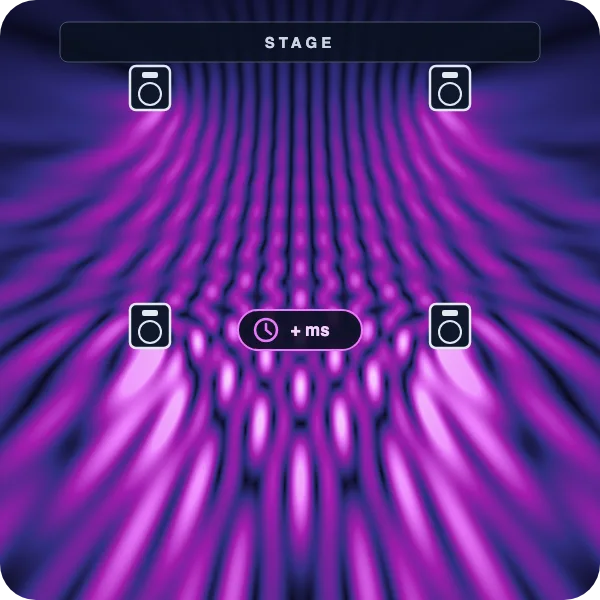
It seems obvious: if two speakers are good, four must be better. More speakers, more power, more sound. But anyone who has stood in a hall with an extra pair of speakers thrown in halfway down the room knows it can sound worse: hollow, echoey and blurry, with speeches harder to understand than before. The reason is interference, and the fix is delay.
Sound is a wave, and waves interfere
Sound travels through the air as pressure waves, at about 343 metres per second. That's fast, but not instant: sound takes roughly 2.9 milliseconds to travel one metre. Each frequency has its own wavelength, from about 17 metres for a deep 20 Hz bass note down to under 2 centimetres at 20 kHz.
When two speakers play the same music, your ears receive two copies of every wave. If they arrive in step (peak with peak), they add up and get louder. If they arrive out of step (one's peak with the other's trough), they cancel out. Most of the time it's somewhere in between, and which one you get depends on the frequency and on how much further one speaker is from you than the other.
Comb filtering: why extra speakers can sound hollow
Imagine you're standing 1 metre closer to one speaker than the other. The far speaker's sound arrives 2.9 ms later. For a note of about 172 Hz, that's exactly half a wavelength, so the two copies cancel. At about 515 Hz it's one and a half wavelengths, and they cancel again. In between, other frequencies add up. The result is a series of deep notches across the spectrum called comb filtering:
Same distance from both speakers
Both arrive together: a clean +6 dB, the same at every frequency.
1 m closer to one speaker
2.9 ms apart: first notch at 172 Hz, then one every 343 Hz.
4 m closer to one speaker
11.7 ms apart: notches every 86 Hz, right through the voice and the bass.
Move a step to the left or right and the notches move. So in a room full of overlapping speakers, every guest hears a different, slightly broken version of the music. Speech suffers most: the notches land on the frequencies that make words clear, so the MC sounds boomy in one spot and thin in another. In practice, room reflections smooth some of this out, but the effect is clearly audible as a hollow, "phasey" sound that changes as you move around.
Two speakers on a stage already do this a little in the middle of the room. That's normal, and a good system is set up to keep it under control. The trouble starts when more speakers are added without thinking about timing.
Why four tops can sound worse than two
- Overlapping coverage. Four speakers aimed at the same crowd create far more places where two or more of them overlap at different distances, so there's more comb filtering, not less.
- Side-by-side stacking. Two speakers placed next to each other on the same side sound fine straight ahead, but off to the sides their sound arrives at different times and cancels in places, creating "dead" spots.
- Speakers moved forward into the hall. This is the big one, explained below.
- Mismatched speakers. Different models have different tonal balance and, with built-in digital processing, can add slightly different internal delays, so they don't line up even at the same distance.
- Reversed polarity. A miswired cable or wrong setting makes one speaker push while the other pulls, cancelling the bass across the room.
The problem with moving speakers forward
In a long hall or marquee, guests at the back are a long way from the stage, so it's tempting to set up a second pair of speakers halfway down the room. Now think about a guest at the back of the room:
- The forward speakers are close, so their sound arrives first.
- The stage speakers are, say, 12 metres further away, so the same sound arrives about 35 ms later.
At those timings, the ear no longer blends the two arrivals into one sound. Every drum hit and every word is heard twice, which sounds like an echo, or a smeared, muddy blur in a reverberant room. Speech becomes hard to follow, and the sound seems to come from the speaker beside you rather than from the stage. Gaps much beyond 30 to 50 ms are heard as a distinct echo.
The fix: delay the forward speakers
The solution is to hold back the signal going to the forward speakers by exactly the time it takes the stage sound to reach them. Then, at the back of the room, the sound from the stage and the sound from the delay speakers arrive together, and the two add up instead of fighting.
Step 1: measure the distance
Measure from the stage speakers to the forward speakers, in metres.
Step 2: convert it to milliseconds
Multiply the distance by 2.9 (or divide by 343 and multiply by 1,000). That's the time the stage sound takes to reach the forward speakers.
Step 3: add about 10 ms
If the stage sound arrives just a little before the delay speakers, our hearing locks onto the first arrival and places the sound at the stage. This is called the precedence or Haas effect, and it works even when the delayed speaker is somewhat louder. So add roughly 10 ms on top. The audience hears a clear, loud sound that still seems to come from the band or MC.
| Distance from stage speakers | Travel time | Suggested delay (+10 ms) |
|---|---|---|
| 8 m | 23 ms | 33 ms |
| 12 m | 35 ms | 45 ms |
| 16 m | 47 ms | 57 ms |
| 20 m | 58 ms | 68 ms |
| 25 m | 73 ms | 83 ms |
Step 4: set the levels and aim
Delay speakers are there to top up the back of the room, not to compete with the stage. Point them at the rear area only, keep them lower in level than the mains, and avoid aiming them back towards the stage, where their sound arrives late and causes the same problem in reverse. Finish by listening from several spots in the room and fine-tuning by ear.
You need a digital mixer or speaker processor with output delay to do this. A basic analogue mixer can't delay an output, so forward speakers fed from it are always early.
When two speakers are the better choice
For most parties and weddings, a single pair of good speakers on stands, with subwoofers for the low end, covers the whole room better than four speakers scattered around it. Lift the speakers above head height so the sound carries over the crowd to the back, and angle them to cover the room without overlapping too much. Our guide to choosing the right PA size explains how to match the system to your guest count and venue.
For large weddings, school dances and long venues where one pair isn't enough, our Array Set has two pairs of tops and two subwoofers. Tell us your venue layout and we'll recommend how to place them. You can also browse all our speaker sets.